Opening a Restaurant? A 30-Day Content Plan Beyond the Countdown
A countdown creates anticipation only if people understand what is opening and why they might visit. For a small restaurant team, the first month of content should also reduce repeated questions and avoid promises that operations cannot deliver. This four-week plan is an editorial working template, not a prescribed posting frequency or a guaranteed launch result.
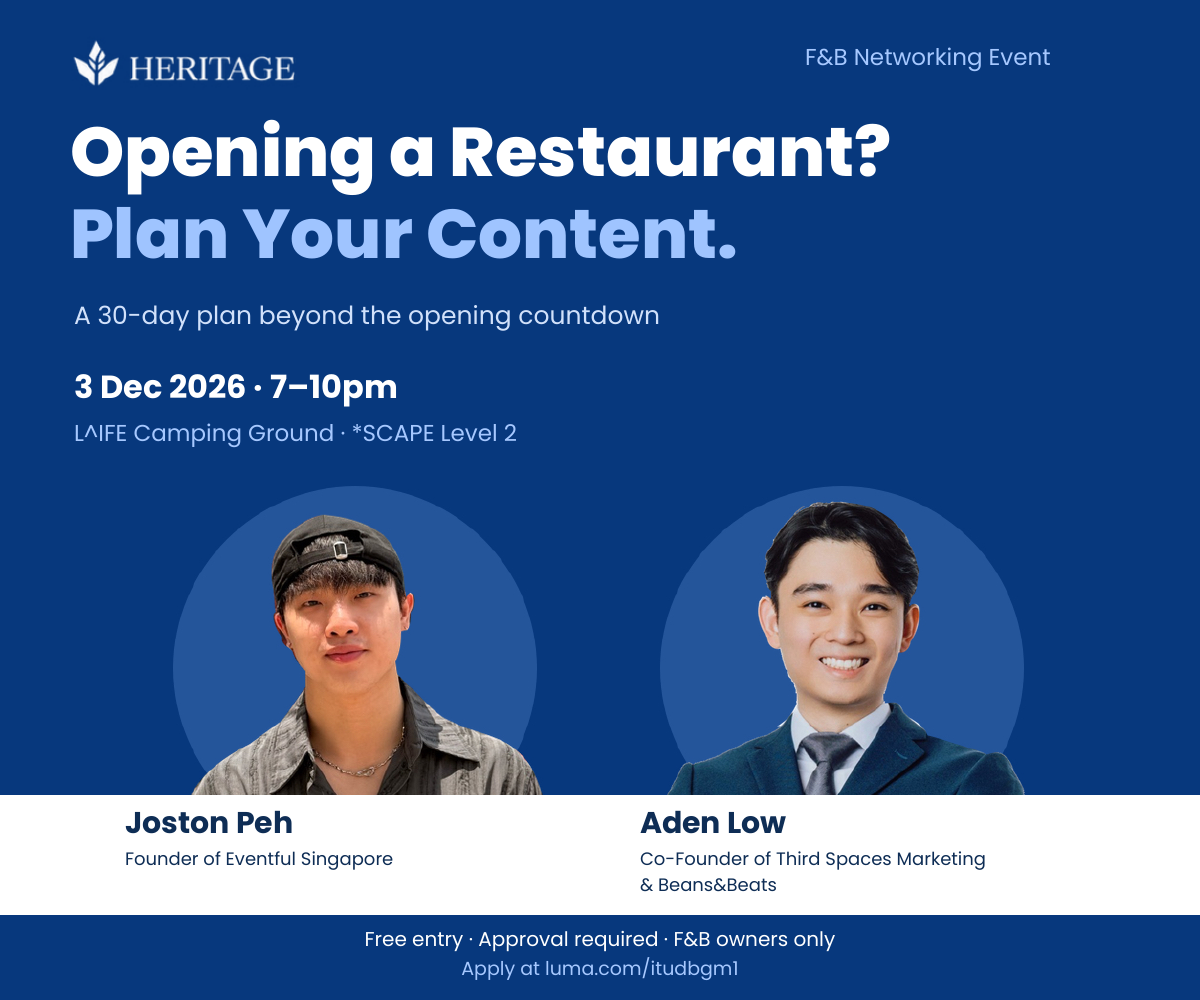
Photo: Heritage Singapore / Eventful Singapore
Week 1: settle the information customers need
The team should confirm the outlet name, address, opening arrangements, menu and contact route before building promotional posts. Any detail still provisional should remain clearly provisional. A shared fact sheet helps prevent different staff members publishing conflicting information. Google’s local-business guidance recommends accurate, complete details; the website, map listing and social profile should give customers a consistent starting point.
Week 2: explain the reason to visit
The next set of stories can introduce a signature dish, the intended dining occasion and a real decision behind the concept. Each post should answer one question rather than compress the entire business plan into a caption. A hypothetical lunch-led restaurant might show the serving format and ordering process. That is a suggested angle, not a claim about what every new restaurant should sell.
Week 3: rehearse the customer journey
Before inviting a larger audience, someone unfamiliar with the setup should follow the booking or enquiry link on a phone. The team should check dates, confirmation messages, directions and who receives enquiries. A short video can show arrival and seating without revealing customers’ personal information. If the outlet is not ready to accept reservations, the content should say what interested diners can do now instead.
Week 4: publish useful opening information
The opening post should make the date, outlet and next action easy to find. Any launch offer needs its actual conditions, availability and relevant exclusions, not an invented deadline. Staff should know where to direct questions and how to correct a changed detail. Updates should replace stale information wherever practical, rather than leave several contradictory announcements for customers to interpret.
Review the first month without rewriting history
The team can record enquiries, booking completions and customer questions alongside content performance. Those are different measures: a viewed video is not a completed reservation, and a booking is not automatically an attended meal. The next month’s plan can address repeated confusion and expand genuinely useful stories. A short review of what the team can sustain is more actionable than declaring every weak post a platform problem.
Discuss content with other F&B owners on 3 December
F&B owners can bring a specific content question to Heritage Singapore’s Your First 10K Followers networking evening, featuring Joston Peh and Aden Low. It takes place on 3 December 2026, 7–10pm, at L^IFE Camping Ground, Level 2, *SCAPE, 2 Orchard Link.
Entry is free, strictly for F&B owners and subject to approval. No food or drinks are provided. See the event details and apply on Luma →