How to Compare Restaurant Deals in Singapore
A restaurant deal is useful when it lowers the cost of the meal you wanted to buy. Compare the final bill, eligible dishes and restrictions before letting a 1-for-1 headline choose the restaurant for you.
Build one realistic order first
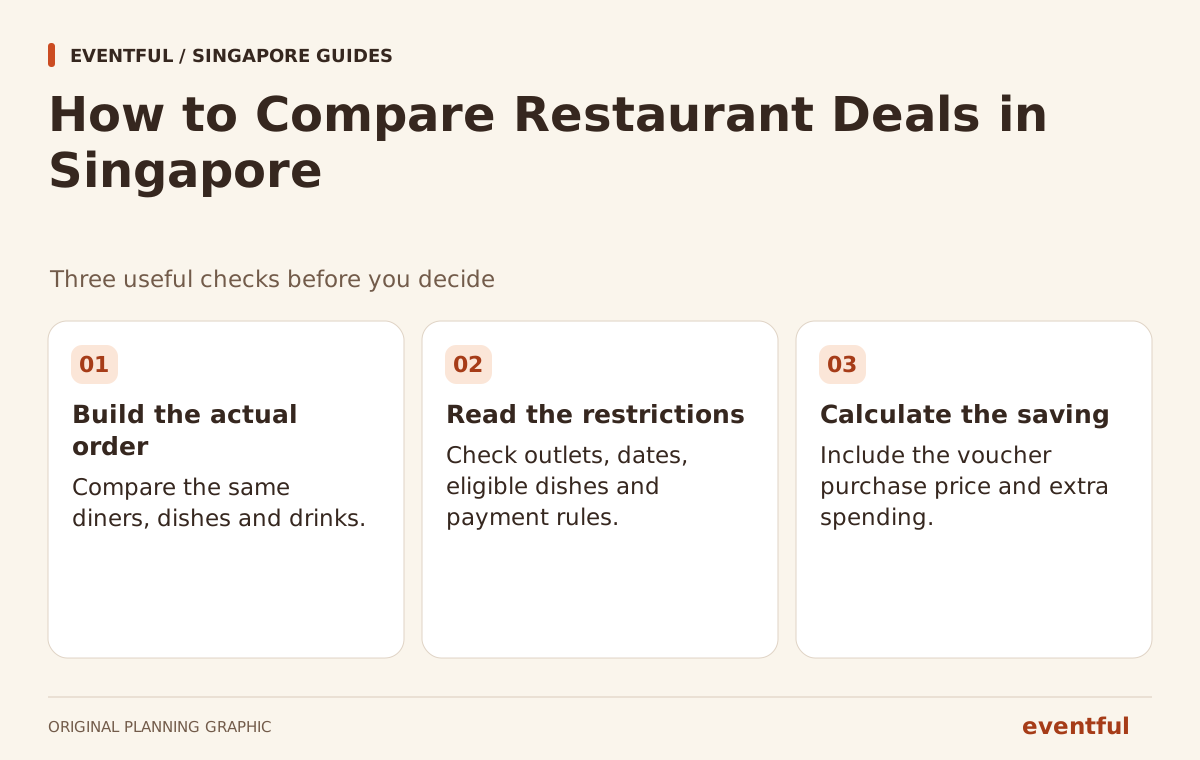
Write down the number of diners, likely dishes and drinks before comparing offers. A two-person dinner is not automatically cheaper because one main is free. The paid main might cost more, the deal may require drinks, or the eligible menu may be different from the one you wanted.
Choose the occasion first with our couples’ outing guide or another relevant shortlist. Then compare the same kind of meal across venues. If the promotion makes you order substantially more than you would otherwise eat, treat that extra spending as part of the deal’s cost.
Read what 1-for-1 actually covers
Check whether the free item must be the same dish, comes from a restricted list or is the lower-priced selection. Confirm the number of redemptions allowed per table and whether splitting bills is permitted. Look for exclusions affecting weekends, public holidays, set menus, takeaway or other promotions.
Here is a hypothetical example: you order eligible mains costing S$30 and S$20, and the cheaper one is free. The food subtotal falls from S$50 to S$30, a 40% reduction, not 50%. If you also buy two S$8 drinks that are not discounted, the subtotal is S$46 before applicable charges. The meal may still be worthwhile, but the headline alone does not tell you the saving.
Compare the final payable amount
Ask whether service charge and GST apply and how the discount affects them. Also include booking fees, compulsory purchases and any voucher purchase price. A voucher bought for S$20 that takes S$30 off the bill is not a S$30 saving. Your net benefit is S$10 before considering restrictions or additional spending.
Singapore’s Competition and Consumer Commission identifies drip pricing, price comparisons, discounts and use of the word “free” as key price-transparency issues. Its guidance emphasises clear disclosure of unavoidable charges and material conditions. For diners, the practical habit is simple: locate those conditions before paying rather than after the meal.
Check that you can actually redeem it
Read the expiry date, eligible outlet, reservation method and payment requirements. A valid voucher does not guarantee a table at your preferred time. If an offer requires a particular booking channel or code, complete that step as directed and keep the confirmation.
For prepaid deals, check cancellation and refund conditions before purchase. Save the terms that applied when you bought, especially if the offer page may disappear. At the restaurant, mention the promotion before ordering and confirm which items qualify. If staff cannot reconcile the offer with your booking, resolve it before treating a full meal as discounted. Do not buy several vouchers just because the first looks attractive.
Good to know
· For a group, ask whether the offer is per diner, per pair, per bill or per table.
· Compare against what you would otherwise spend, not only the seller’s stated original price.
FAQs
Does 1-for-1 always mean half price?
No. Unequal item prices, excluded drinks and compulsory extras can make the overall discount smaller.
Should I buy a voucher before checking table availability?
For a date-sensitive meal, check availability and redemption conditions first. A voucher and a reservation are separate things.