Food Shop or Food Stall? Start With Who Controls the Seating.
A counter inside a food court does not automatically mean you are applying as a food stall. The Singapore Food Agency distinguishes a stall inside a larger food shop from an operation responsible for its own refreshment area. Check that difference before using someone else’s opening checklist.
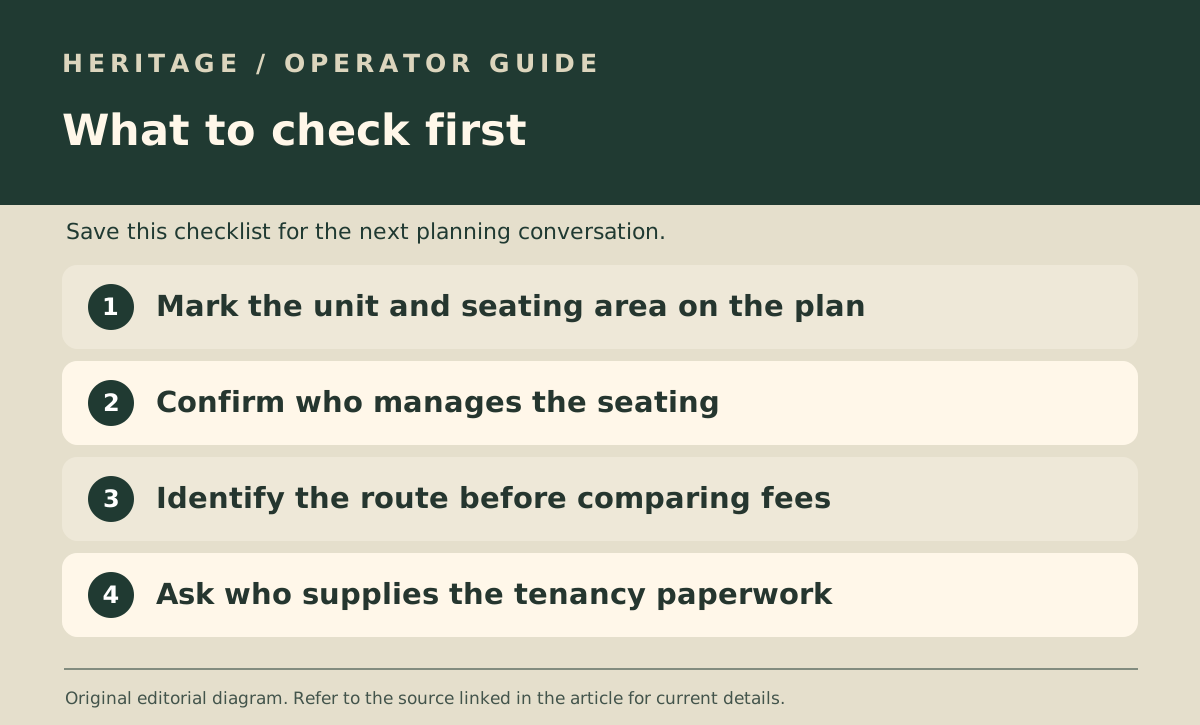
Draw the boundary before you name the licence
Mark the preparation area, the sales counter and the seats on a copy of the proposed layout. Then write down who is responsible for each. SFA’s guide says a stall operating within a food shop but responsible for its own refreshment area falls under the Food Shop licence type. The name on the shopping centre directory is not necessarily the answer.
This is why someone opening a counter in one property can need a different application from a friend with a similar menu elsewhere. Look at the actual operating arrangement and use SFA’s business-type examples.
Get the unit right on the paperwork
For the Food Stall pathway, SFA asks for a dimensioned, scaled layout that identifies the exact stall within the host venue. The page also describes tenancy documents and the applicable stamp-duty evidence. Ask your prospective host to identify the unit and which documents it can supply; do not assume its own licence or paperwork covers your counter.
For an existing stall takeover, SFA says the incoming operator should notify the outgoing operator to cancel the old Food Stall Licence. Resolve that handover in the planning conversation rather than assuming a licence is part of the fixtures.
Compare the fees only after the route is clear
SFA currently lists S$195 per year for a Food Shop Licence and S$32 per year for a Food Stall Licence (or S$64 for two years). Those are listed licence fees only, not your rent, deposits or fit-out budget. Check the application process page for requirements specific to the route.
There are separate arrangements for stalls in certain publicly managed hawker centres. If that is your location, check with the managing agent rather than assuming the private food-court workflow applies.