Wheelchair Outings: Check the Whole Route, Not Just Entry
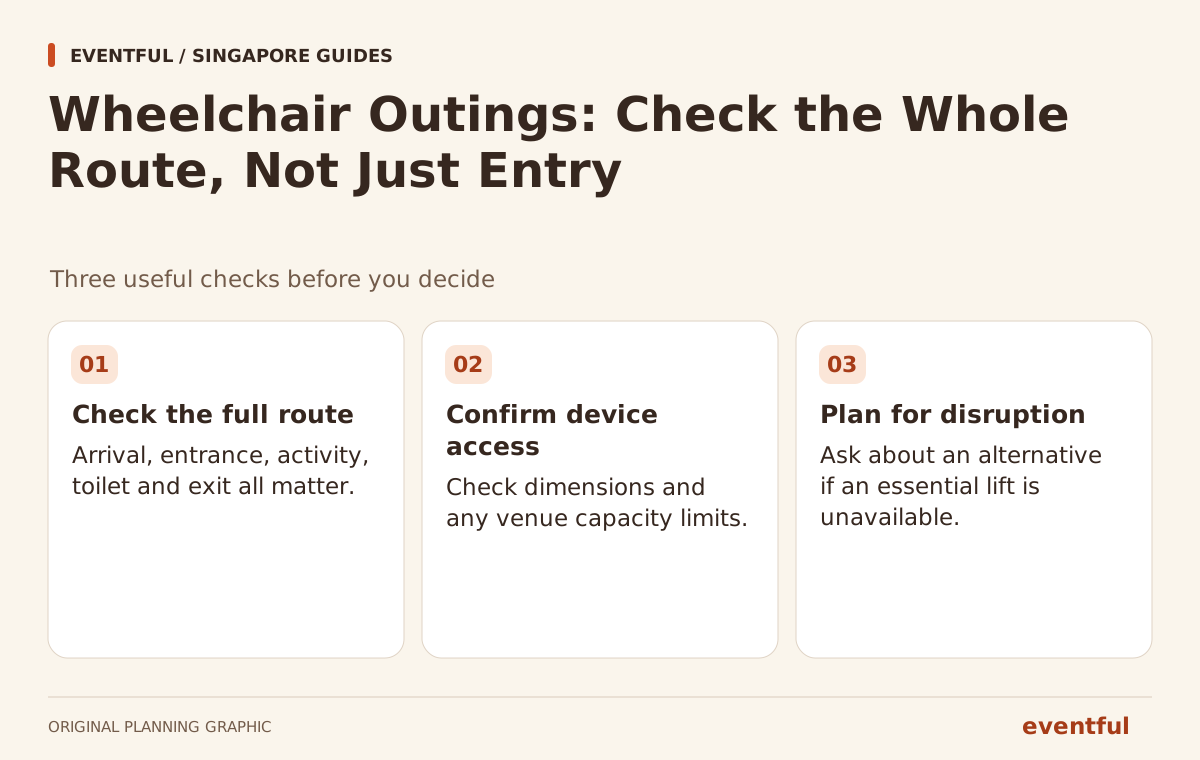
Check the complete journey from arrival to departure before choosing an outing. An accessible entrance does not answer every question about galleries, toilets, transport or space for your device.
Start with the person and device
Ask the wheelchair user what matters for this outing: distance, slopes, transfers, seating, toilet access or room to manoeuvre. If using a powered device, note the dimensions and any other information the venue needs to confirm access. Avoid making assumptions based only on the word wheelchair.
Our Civic District museum comparison helps choose a subject or institution. Use this separate checklist to decide whether the route works for the individual visiting. A companion should support that choice rather than treating an accessible outing as a single category of experience.
Use SAM as an example of a specific access enquiry
Singapore Art Museum’s visitor information states that all galleries at Tanjong Pagar Distripark are wheelchair accessible. It also identifies a side ramp at Block 39 and a platform lift at the rear. Those details are more useful than an isolated accessible symbol because they help you identify the correct approach.
SAM lists complimentary manual wheelchairs on a first-come basis. If a wheelchair is essential throughout the visit, do not rely on unreserved loan equipment without discussing the arrangement first. The museum also publishes limits for personal mobility aids, so check your device against the current requirements rather than assuming every powered device is admitted on the same terms.
Ask about the route from your actual arrival point, not simply the address. A taxi drop-off, MRT exit and parking space may lead to different approaches.
Look for constraints as well as facilities
Chinatown Heritage Centre says all levels have lift access, but some spaces are narrow and it limits admission to three wheelchair users at a time. That makes capacity and manoeuvring part of the planning question, even though a lift is present.
Mandai’s accessibility information describes tram and shuttle provision, but services differ by park. At Bird Paradise the shuttle links the entrance and Central Plaza; it is not a substitute for exploring every aviary. Night Safari says some trams have wheelchair slots, which is a reason to ask about boarding rather than assume every vehicle is identical.
For any venue, ask about the particular gallery, activity or presentation you want. An accessible public area does not necessarily establish access to every optional experience.
Write a short route and a fallback
Build the visit as a chain: arrival point, entrance, ticket check, first activity, accessible toilet, rest stop and exit. Confirm any link that would make the day fail if unavailable. Save the venue contact and the relevant access page so you can explain the arrangement if plans change.
Check live lift or transport notices before leaving and allow time for an alternative route. If a lift is essential, ask what happens during an outage rather than assuming staff can safely improvise a transfer. Nobody should have to accept an unsafe transfer to complete an outing.
Keep the initial plan modest and add another stop only if the visitor wants it. For other ideas, browse our Singapore guides, then apply the same whole-route check. The useful recommendation is a confirmed route for a particular person, not a blanket promise that a venue suits everyone.
Good to know
· Confirm the route from your actual drop-off or station exit.
· Ask about device dimensions and capacity limits before a group visit.
FAQs
Is lift access enough to confirm a suitable visit?
No. Check the approach, narrow spaces, toilets, activity access and any device or capacity restrictions as well.