Leathercraft Workshops: Small Accessories or a Bigger Project?
For a first leathercraft workshop, a small usable accessory is a sensible starting point. Crafune’s three-accessory class makes a keychain, coin pouch and card sleeve in a listed three-hour session, including an introduction to saddle stitching.
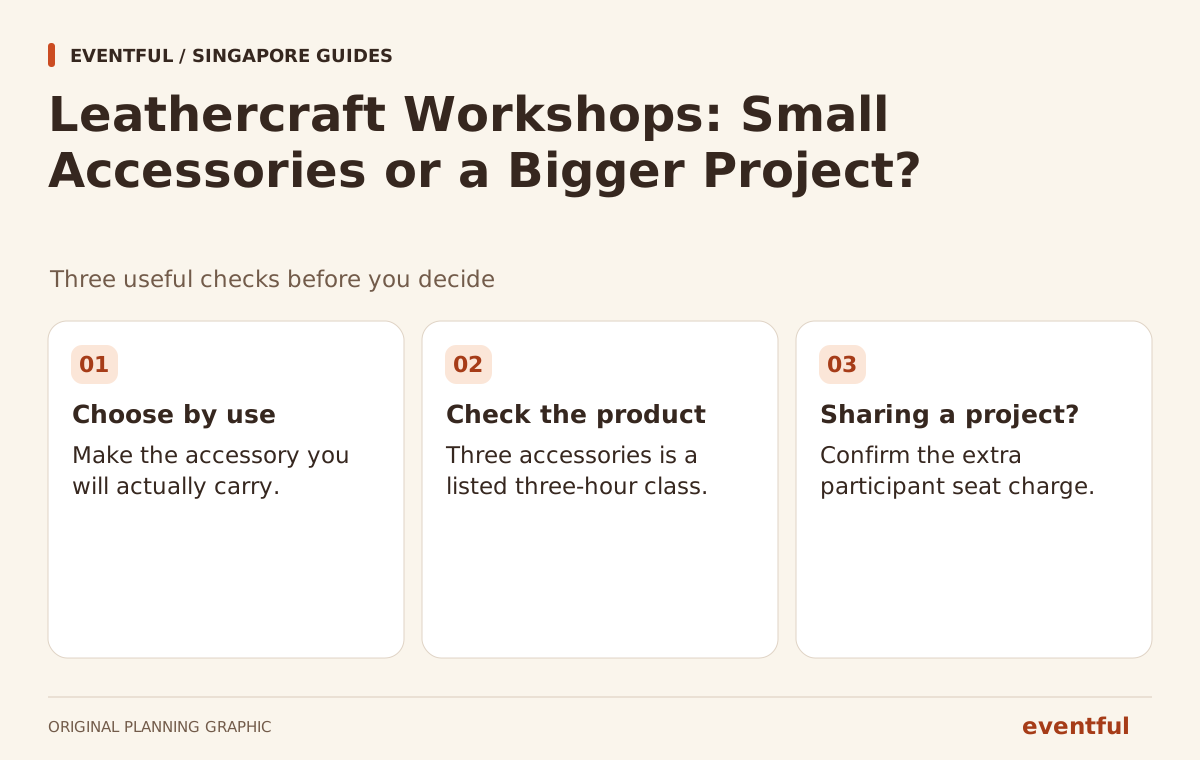
Choose the item you will carry
Look at what you actually use: keys, cards, coins or an ID lanyard. A project is more satisfying when it fits your daily routine than when it looks impressive only in the class photo. Check the dimensions against the cards or items it needs to hold.
For a different material, our pottery workshop comparison explains the trade-offs around clay and firing. Leathercraft has a different appeal: learning how flat material becomes a useful object through cutting, joining and finishing.
What the three-accessory option teaches
The Crafune class page lists leather basics, tools, scoring, cutting, gluing, saddle stitching, edge finishing and care. It supplies tools and materials and says participants take their creations home after the workshop.
The advertised set is a keychain, coin pouch and card sleeve. It is a useful format if you want to try several small shapes without committing to a bag. It also makes sense if you would rather use a simple piece than spend the whole class chasing a more elaborate design.
Check the price and location for the exact product
The Haji Lane three-accessory listing shows S$89 and a three-hour duration, with no prior knowledge required and a minimum age of ten. The workshop catalogue identifies the Haji Lane address as 38A Haji Lane, #02-01.
Do not assume the same item, timing or price applies at another Crafune location. Open the chosen product and date, then check the final total. If accessibility matters, ask about the route to that particular studio before committing.
Bigger is not automatically a better first class
A wallet or bag might be the right choice if that is the object you want, but check its listed duration and techniques. The number of finished pieces does not tell you how much stitching or concentration the session requires.
For two friends choosing different projects, ask whether the sessions can be scheduled together and when each will finish. A shared outing works better if nobody is waiting a long time for the other person’s last seam.
Customisation and sharing need specific answers
Crafune describes personalising the small accessories with initials, names or dates. Decide your spelling before the class and keep it short enough for the chosen surface. Ask which options are included rather than assuming any logo or complex artwork can be reproduced.
The product FAQ says booking is required. Additional participants sharing a booking incur an extra seat charge. Confirm that amount and arrangement instead of buying one place for two people and expecting it to work at the door.
Do not book from an old listing alone
The General Co’s Leathercraft 101 page currently shows sold out and retains old safe-reopening text. It is not a reliable source of an available upcoming session. We have not presented its price or dates as a live alternative.
Use a current selectable session and read the cancellation policy before paying. Ask how to care for your finished leather at the end of class, especially if it will live in a bag or pocket every day. Browse more craft and outing guides in the Eventful blog.
Good to know
· Check dimensions against the cards you carry.
· Keep custom initials and spelling ready.
· A shared project may still require a paid second seat.
FAQs
Is the three-accessory class suitable for beginners?
Crafune says no prior knowledge is required and lists age ten and above.
Can two people share one booking for free?
Do not assume so. Crafune’s FAQ says an additional participant pays for the extra seat.